
2026 AI-Native Enterprise Transition and Practical ROI Acquisition Strategy

The Era of AI Magic is Over, It's Time for 'Value Proof'
The most critical buzzword for 2026 is not the spec competition of sophisticated models. It is the transition to the 'AI-Native Enterprise' and the 'Acquisition of Practical AI ROI' through it.
Just 1 or 2 years ago, companies hurried to start pilot projects (PoC), saying "Let's try something like ChatGPT too." But the results were cold. According to research, many generative AI projects fail to prove measurable financial returns (ROI) within 6 months and stop at the laboratory stage.
Now, investors and boards demand clear answers: "So how much did we earn with AI, and how much did we reduce costs?" The era of vague experimentation is over. Now is the era of Proof of Value (PoV). Here are the 5 core strategies to redesign the entire organization around AI and achieve true ROI in 2026.
1. Precisely Target High-Value Areas with a Top-Down Approach
When first adopting AI, many companies chose a Bottom-up approach of gathering employee ideas. However, this method might seem to have high adoption rates but often ends in scattered experiments rather than enterprise-wide business innovation.
To create actual results, strong sponsorship from top management and a clear Top-down strategy are essential. Leadership must directly select a few core workflows where business priorities, the possibility of AI value proof, and data availability align.
Especially in 2026, 'Agentic AI', which plans by itself, coordinates multiple models and systems, and acts autonomously, has settled as the heart of enterprise intelligence. Leaders must use this Agentic AI to integrate fragmented workflows and deploy dedicated teams to solve problems deeply.
2. Win with 'Business Metrics' and 'TCO' instead of Technical Metrics
Technical metrics like model accuracy or latency alone cannot persuade management. Successful companies set clear practical business Key Performance Indicators (KPIs) such as operating cost reduction, margin improvement, revenue growth, and processing speed enhancement before starting AI projects.
Furthermore, a cold Total Cost of Ownership (TCO) analysis of IT infrastructure costs must follow. Strategic judgment is needed on whether to subscribe to commercial LLM APIs or build open-source models on-premises.
- Cost Optimization Tip: Research shows that for medium-sized workflows processing 10 to 50 million tokens per month, optimizing and deploying high-performance open-source models can break even within 6 to 24 months compared to commercial APIs. A hybrid infrastructure strategy considering security and cost is the key to achieving true ROI.
3. Redesign the Talent Framework with the '4B Strategy'
Introducing AI into a broken existing process only repeats inefficiencies faster. As AI agents handle the middle steps of practical work, employee roles must also evolve into 'AI Generalists' who coordinate and oversee agents.
To this end, organizations must balance the talent framework through the 4B Strategy:
- Build: Enhancing AI literacy of existing personnel
- Buy: Securing AI architects and engineers
- Borrow: Utilizing professional partners like NexusForce
- Bot: Completely automating repetitive knowledge labor
The work culture itself must be redesigned so that employees make strategic judgments based on insights generated by AI and play the role of orchestrators for agents.
4. Prerequisite for Production Deployment: Triple Guardrails
When AI leaves the lab and is deployed in actual operating environments (CRM updates, payments, etc.), risks such as data leakage or wrong actions occur. Therefore, a powerful Triple Guardrail architecture for compliance and security is essential.
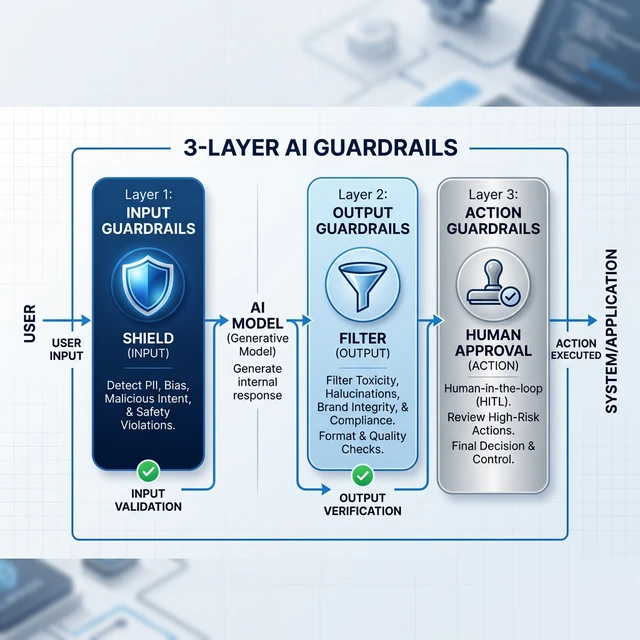
- Input Guardrails: Preventing prompt injection and PII filtering
- Output Guardrails: Hallucination detection and fact-based grounding check
- Action Guardrails: Restricting tool calling permissions and introducing human approval (Human-in-the-loop) for high-value payments
5. Build a Virtuous Cycle of Innovation with a Single Orchestration Layer
Managing various AI agents and data individually only increases technical debt. To handle complex high-value tasks, an 'Orchestration Layer' where even non-experts can intuitively combine and manage agents in workflows is essential.
Successful organizations create a 'Virtuous Cycle of Innovation' structure where they pay off existing operational debt with the AI system built this way and reinvest the saved costs into new innovation projects.
Conclusion: AI is Not a Magic Wand
The magic where results come out just by adopting AI doesn't happen. The winners in 2026 are not companies buried in AI model specs, but 'AI-Native Enterprises' that have embedded AI into the core infrastructure and the way they work itself.
Please check right now if your organization is focusing on short-term Proof of Value (PoV) and if it has a strong governance and talent development plan.
NexusForce analyzes your business workflows and proposes an AI-native transition strategy that creates substantial ROI. Get an AI adoption maturity diagnosis today.